
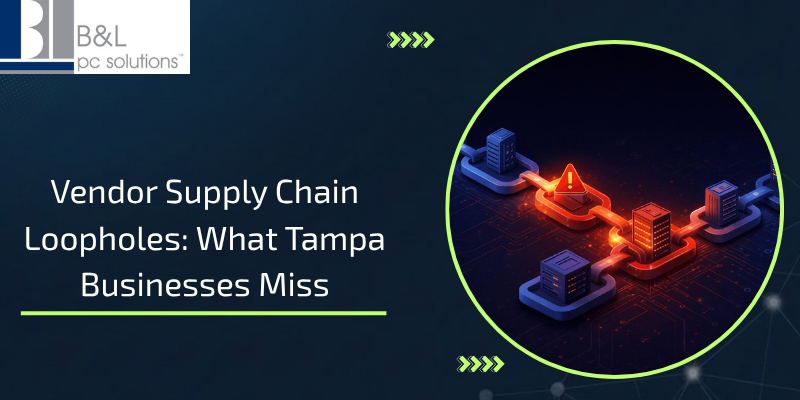
You know how routine compliance weeks go in Florida. Stacks of vendor agreements sit on your desk, legal keeps emailing about updated service-level terms, and operations is just trying to get a new cloud logistics tool deployed before the end of the quarter. Everyone assumes that because a software provider is well-known, their backend security is bulletproof.
Then your managed service provider calls because outbound traffic is pinging a strange server at two in the morning.
The security breach didn’t come from a guessed password or a generic phishing email. It slipped through a trusted third-party software utility your team installed six months ago to handle digital invoicing. That vendor had direct, unmonitored access to your core infrastructure, and attackers used that open digital doorway to bypass your firewalls entirely.
For regional business leaders, operations heads, and compliance directors across the Tampa Bay area, supply chain risk has become an operational headache. When an external partner gets compromised, your entire network inherits their weakness. Recognizing how these digital blind spots happen is the baseline for keeping your business secure.
If you are evaluating your overall resilience, exploring B&L PC Solutions is a solid starting point for understanding modern vulnerability management
Why Supply Chain Loopholes Are a Hacker’s Best Friend
Modern organizations rely heavily on external software tools, cloud platforms, and remote management utilities to function efficiently. Every single connection creates a digital touchpoint.
Cracking a fortified enterprise network head-on is a grueling task. Hackers quickly realized it's much easier to bypass the front door entirely.
Instead, they target smaller software vendors, standard remote monitoring and management (RMM) utilities, or third-party billing portals with softer security postures. One compromised vendor instantly hands them an all-access pass into every downstream client connected to that system.
Tampa businesses typically encounter hidden vulnerabilities across a few key areas:
- Unmonitored Vendor Privileges: External contractors frequently retain permanent administrative access long after a project concludes, leaving a wide internal path open if a vendor employee relies on a weak password.
- Unpatched Software Utilities: Third-party applications running on local endpoints often miss critical security patches, creating easy entry points for automated malware campaigns.
- Blind Trust in Compliance Checkboxes: Assuming an external vendor is secure just because they signed a standard vendor agreement leaves blind spots that active technical audits are meant to catch.
Waiting around for a breach to wreck your systems is a terrible strategy, which explains why smart execs dive into details on IT support in Tampa, FL, how B&L PC Solutions keeps your business running 24/7 to lock down outside vendor access before trouble starts.
The Difference Between
Direct Network Attacks & Third-Party Supply Chain Breaches
Corporate leadership must understand how supplier-based loopholes differ from standard perimeter threats.
| Attack Vector Dimension | Direct Perimeter Intrusion | Third-Party Supply Chain Compromise |
|---|---|---|
| Entry Point | Exposed remote desktop protocols, weak employee passwords, or generic phishing links. | Trusted vendor credentials, compromised software updates, or shared API connections. |
| Detection Speed | Usually flagged quickly by modern firewalls and anomaly-detection gateway tools. | Extremely difficult to spot because traffic originates from a pre-approved, trusted partner source. |
| Initial Footprint | Limited to the specific endpoint or user account the hacker managed to compromise. | Broad and deep, often granting instant administrative visibility across multiple client systems. |
| Mitigation Complexity | Straightforward password resets, device isolation, and standard endpoint cleanup procedures. | Requires deep forensic auditing, revoking external API keys, and examining all vendor access logs. |
How an Expert MSP Audits Third-Party Touchpoints
Stopping supply chain infiltration requires active oversight rather than passive trust. Comprehensive security assessments look far beyond standard firewalls to evaluate every external connection entering your business environment.
1. Mapping All Active Vendor Connections
An effective audit starts by cataloging every piece of third-party software, cloud utility, and external contractor account touching your network.
2. Enable Strict Least-Privilege Rules
Handing a third-party partner open-ended admin control over your whole system completely invites trouble. Security audits enforce strict boundaries, ensuring vendors only access the specific database or application required for their exact task.
3. Continuous Monitoring of External Traffic
Because supply chain attacks mimic legitimate administrative traffic, systems require continuous oversight. Partnering with a reliable provider ensures that unusual behavior from a vendor portal is flagged immediately, much like studying lessons from when a ransomware hit a Tampa business last year, here's what they wish they had done.
Secure Your Business Operations Today
Relying on informal handshake agreements with third-party vendors leaves your financial records and client data exposed to sophisticated supply chain loopholes. Protecting your enterprise requires an active security posture managed by experienced local professionals.
Deep vulnerability assessments or robust cyber security solutions will lock down your network perimeter, and having expert guidance makes all the difference. Comprehensive managed IT services combined with dedicated partnerships from top-tier providers allow B&L PC Solutions to help organizations build resilient, practical defenses against evolving digital threats.
Safeguard your organization against hidden supply chain risks today!
Get in touch with our team & schedule an executive risk assessment.
Tags: cyber security services, external network touchpoint audits, IT support in Tampa, managed IT services, RMM tool security loopholes, supply chain software vulnerabilities, third-party vendor risk auditing, vendor access control management