
Managed IT Services for Healthcare provide IT solutions to healthcare providers, focusing on independent practices and health systems. These services meet critical functions involved in data processing, communication flows, cybersecurity, and compliance with the legislation. By handling these essential technology areas, outsourced IT Services in Long Island for Healthcare industry allow medical experts to focus on what matters most and provide high-quality services to the patients.
The table below outlines various types of healthcare technologies, their primary purposes, and the impact they have on patient care and operational efficiency:
| Technology Type | Primary Purpose | Impact on Healthcare |
|---|---|---|
| Electronic Health Records (EHR) | Centralize patient data | Reduce errors, streamline access, and enhance decision-making. |
| Telehealth | Enables remote patient consultations | Increases access to care, reduces travel, and minimizes wait times. |
| Patient Data Analytics | Analyzes data for predictive insights | Identifies health trends and supports preventive care. |
| Medical Imaging & Diagnostics | Diagnosis through imaging and diagnostic tools | Improving the accuracy and time for early detection of diseases. |
| Remote Patient Monitoring (RPM) | Tracks patient vitals from home | Improves readmission results and real-time health management. |
| Artificial Intelligence (AI) | Assists in diagnostics or predictive analysis | Promotes accuracy, faster diagnostics, and provides assessment of risk aspects. |
| Cybersecurity Systems | Protect patient data and system integrity | Ensure HIPAA compliance, and prevent data breaches. |
In What Ways Technology is Revolutionizing Health care?
Technology is ingrained in the healthcare industry and affects many specialties, including EHR, Telehealth, Diagnostics, Patient monitoring systems, and others. Research has shown that healthcare technology has significantly benefited patients by improving results, decreasing readmission rates, and enhancing treatment compliance.
The following section analyzes healthcare technology usage based on critical functions.

(Note: These values are based on the mean of the reported data in recent studies for assessing healthcare technology adoption.)
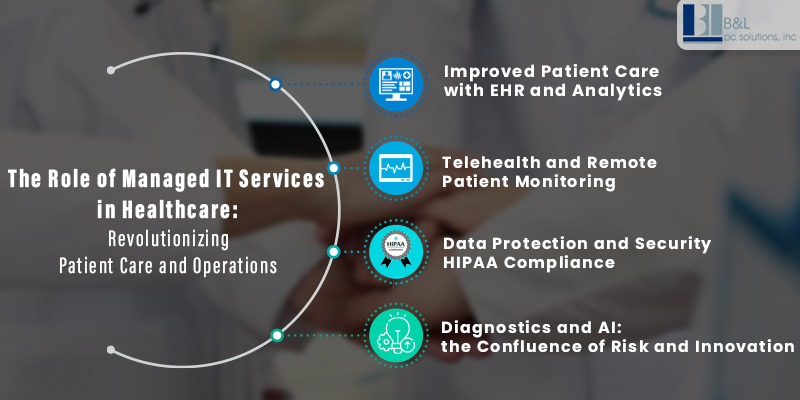
1. Improved Patient Care with EHR and Analytics
Electronic Health Reports (EHR) are kept secure, efficient, and dependable through the Managed IT Services for Healthcare in Long Island.
-
EHR systems offer a cost-effective way to capture data, reduce redundancy in data entry, and minimize the risk of incorrect data input.
-
Healthcare organizations can easily detect potential issues, track chronic conditions, and design suitable interventions in due course.
-
It means that EHR systems, amongst other systems, are well maintained and secure through the IT services handled in Long Island.
2. Telehealth and Remote Patient Monitoring
Telehealth and remote patient monitoring (RPM) systems treat and monitor patients from a distance. This approach reduces the need for patients to visit hospitals or wait in long queues for appointments in a healthcare provider's office.
-
Telemedicine and Remote Patient Monitoring:
Managed IT service providers in Long Island support telehealth by guaranteeing secure communication and the smooth running of technology during remote consultation.
-
Telehealth Billing and Insurance:
IT Services Company in Long Island oversee the implementation of solutions that provide secure and efficient billing and insurance of telehealth services.
-
Remote Patient Monitoring (RPM):
Some remote patient monitoring devices collect and transmit data. The manufacturer of these devices is responsible for ensuring the safe transfer of patients' recognition data to the healthcare unit.
3. Data Protection and Security HIPAA Compliance
As an IT service provider throughout Long Island, we provide robust data protection and security services that meet healthcare institutions' HIPAA compliance requirements to protect patient information.
-
Healthcare data protection and HIPAA compliance.
-
Ensures the patient's information is highly secure with the best security measures implemented.
-
Reduces exposure to threats of data leakage and cyber incidents.
4. Diagnostics and AI: the Confluence of Risk and Innovation
Artificial Intelligence in the diagnosis of diseases is evolving the healthcare system because Machine learning, which means algorithms, can help in the early diagnosis of diseases to enhance key healthcare professionals to address health risks.
-
AI in Medical Diagnosis:
Several developments include artificial Intelligence in medical diagnosis, in which machine learning is used in early disease detection and risk assessment.
-
AI for Faster Diagnosis:
It can easily scan through large quantities of medical documentation, more efficiently notifying specialists of possible health concerns.
-
AI in Radiology and Pathology:
In the case of imaging and pathologic examinations of patients, Artificial Intelligence is an assistive tool for physicians to narrow down the most significant cases and help them render decisions quickly.
FAQs
1. What are the benefits of managed IT service providers to health care practitioners?
Managed IT solutions enhance healthcare by providing security, increasing effectiveness, and meeting all viable legal requirements.
2. Will the Medical Necessity identify the role of electronic health records in patient care?
Modern EHR systems improve patient data management, making it easier to access and reducing the chances of medical errors.
3. Why is cybersecurity critical for healthcare?
Cybersecurity avoids cases where hackers exploit loopholes to steal important details belonging to patients, a clear violation of the client's rights to privacy as required by the HIPAA rules and other laws.
4. In what way does telehealth help the patient?
Telehealth may deliver patient care from distant locations, decreasing transit time for an appointment with a healthcare provider.
5. What is RPM, and what does RPM stand for?
Its real-time health check through Remote Patient Monitoringhelps doctors and nurses check patients online and take appropriate action when necessary.
The Future of Healthcare Technology
IT managed services in Long Island can help healthcare providers prepare for the rise of new threats, rules, and client demands. Effective IT solutions manage the needs of modern healthcare, such as managing and tracking complex electronic medical records, implementing artificial intelligence for diagnosing various conditions, and enhancing patient monitoring.
To learn more about how you can take advantage of the Managed IT Services Long Island implemented by B&L PC Solutions in your healthcare organization, feel free to contact us today for a discussion with our experts about the right solutions for your organization.
Conclusion
The use of technology in the present-day context is undoubtedly essential in the medical field of health care. From improving patient care using EHR and RPM to using advanced AI algorithms for diagnostics – digitalization of the healthcare industry is vital for patient safety, efficiency, and individual approach. However, there are always these challenges and opportunities associated with that – to provide safe, HIPAA-compliant systems, one needs healthcare-managed IT services.
Tags: IT Managed Service Provider Long Island, IT Services Company Long Island, IT Services Long Island, Managed IT Services in Healthcare, Managed IT Services Long Island